About us
How to remove yourself from Radaris (and make the removal stick)
Updated 19 September 2026
Almost everyone assumes the difficult bit of a Radaris removal is getting the form to accept them. It isn't. The form is free, needs no account, and runs about 15 to 20 minutes: find your own profile page, copy its URL, paste it into the removal form at radaris.com/control/privacy, then click a verification link Radaris emails you. Most listings drop out of the site within 24 to 48 hours. The difficult bit arrives later, because Radaris keeps rebuilding profiles from fresh public records, so yours can quietly come back.
Update, 19 September 2026: radaris.com no longer publishes profiles. A New Jersey court entered a default judgment against Radaris.com, Rehold.com and Trustoria.com on August 27, 2026 in a Daniel's Law case brought by Atlas Data Privacy Corp, and the domain was transferred to Atlas. Krebs on Security reported on September 16 that 14 Radaris family domains had been transferred so far. When we checked on September 19, radaris.com, including its /control/privacy form and old profile links, showed only the court-order notice, and so did Trustoria.com, Rehold.com, Centeda.com and Clubset.com. Radaris's lawyer told Krebs it has moved to vacate the judgment and plans to appeal, so the site could return. The steps below describe the removal form as it worked before the transfer. Keep them for that case, and use the recheck advice at the end.
What the form asks for, screen by screen
Do this on a laptop if you have one. The form runs you through several loading screens and two CAPTCHAs, and mobile browsers drop the session more often.
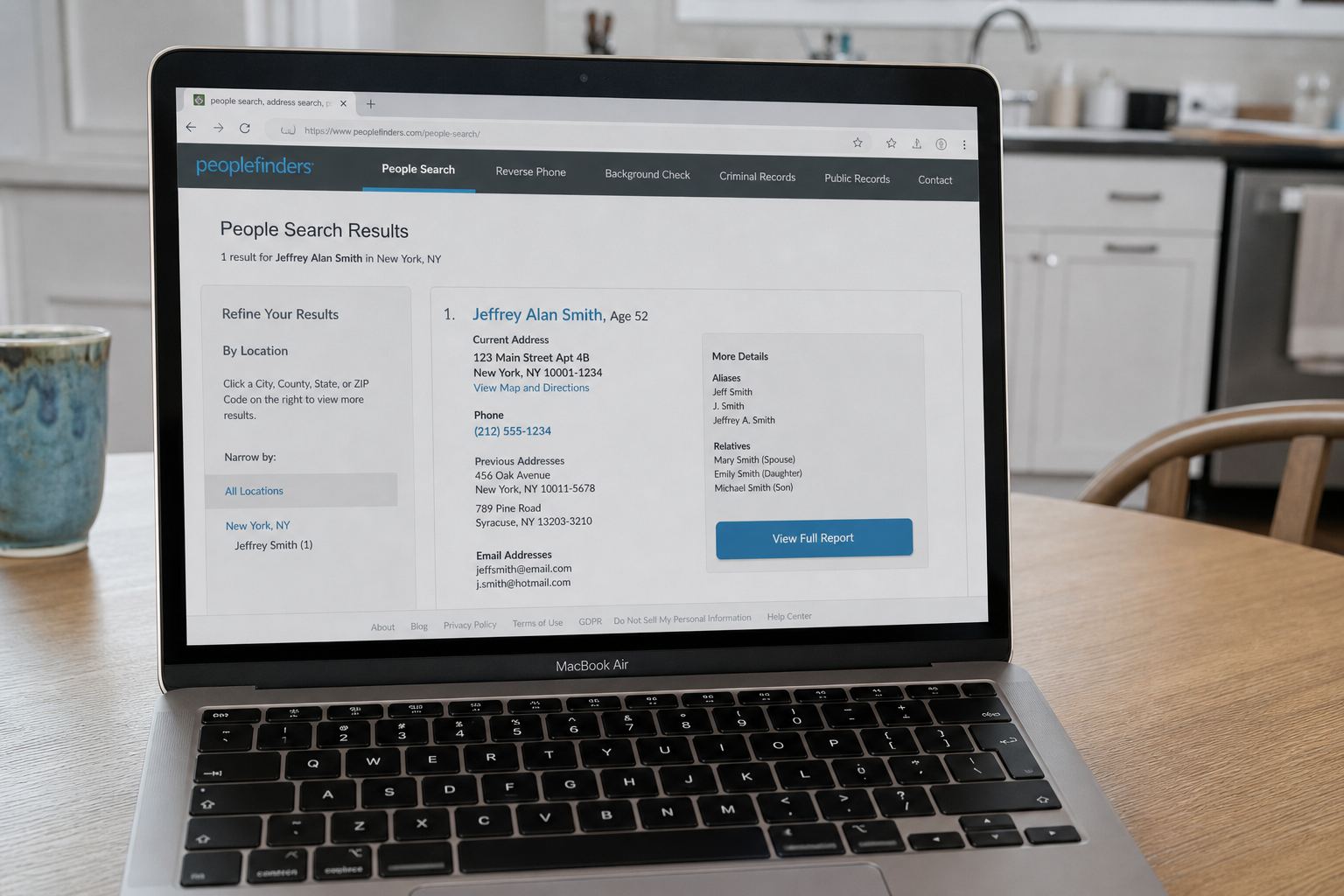
- Search your name plus your city and state on radaris.com. Open the profile that's actually you, not a relative with the same last name.
- Copy the full profile URL out of the address bar. It usually looks like radaris.com/p/First/Last/ followed by a string of characters.
- Go to radaris.com/control/privacy and paste that URL in, along with your name, city and state when the form asks.
- Keep clicking through the confirmation screens until you reach the button marked "Start removing". There are more of these screens than there need to be.
- Enter an email address, solve the CAPTCHA, submit.
- Open the verification email, click the link, wait out the progress bar (roughly ten seconds), solve a second CAPTCHA, submit again.
- You should land on a confirmation screen. That screen is your proof the request went through, not the email you clicked from.
The email step is where most people get stuck
The verification message can take half an hour to show up, and it lands in spam constantly. Check there before you assume it failed. Several removal services report the link expires quickly, somewhere in the 15 to 30 minute range, though I couldn't find an official expiry time published by Radaris itself. Treat it as short-lived and click it the moment it arrives.
If the link is dead by the time you get to it, you start over from the profile URL. Irritating, not fatal.
No, you don't need a Radaris account
This trips people up because it used to be worse. Krebs on Security reported in March 2024 that Radaris pushed people toward creating an account to manage removals, which meant handing a data broker more of your information in order to get less of it published. The current form at /control/privacy only asks for an email address and the profile link.
You also don't need to "claim" or verify your profile. If a screen offers to let you manage or correct your listing instead of removing it, that's the wrong door. Back out and use the removal path.
Use an email address you don't care about
Contacting any people-search site with your real inbox is how you end up on their marketing lists. Make a free throwaway address, use it for this and every other opt-out you do, and keep it. You'll want the same address later when you're checking whether the removal held.
You probably have more than one listing
Radaris builds separate profiles from separate record sources, so one person can have three or four. Search your legal name, then your name with a middle initial, then any nickname you've used on a lease or a voter file, then a maiden name if that applies. Old cities matter too. Each profile URL is its own removal request, and clearing one does nothing for the others.
Radaris is not only radaris.com
The same operation runs a cluster of other sites. Krebs on Security's reporting names Centeda.com, Virtory.com, Clubset.com, Bizstanding.com, Homemetry.com and Trustoria.com among them, with report sales funneled through PersonTrust.com and, at least at the time of that reporting, TruthFinder. Each of those sites has its own removal flow, and opting out of radaris.com doesn't touch them. If you're going to do this properly, search your name on each one.
That TruthFinder connection matters for a second reason. TruthFinder belongs to PeopleConnect, which is a separate company with a separate and honestly better opt-out, so it's worth running the Intelius and PeopleConnect suppression request in the same sitting.
If the form won't cooperate
There's a phone line at (855) 723-2747, listed as Monday through Friday 9am to 5pm ET and Saturday 10am to 4pm ET. There's also a contact form at radaris.com/page/contact. Be prepared to follow up. The Better Business Bureau has given Radaris an F rating, and the reason cited in Krebs on Security's coverage was the company ignoring people who asked to be removed. Keep a screenshot of your confirmation screen and the date.
Radaris has also been sued repeatedly, including a 2014 class action that produced a $7.5 million default judgment, a 2023 Illinois Right of Publicity class action, and a February 2024 suit under New Jersey's Daniel's Law brought by Atlas Data Privacy Corp. That last one is the case that took radaris.com offline in August 2026, as described at the top of this page. Radaris has said it will appeal, which is one more reason to keep rechecking.
California residents have a real shortcut now
If you live in California, you can skip the per-site grind. The California Privacy Protection Agency runs DROP, the Delete Request and Opt-Out Platform, created under the Delete Act. Consumers have been able to submit requests since January 1, 2026, through the state's site at privacy.ca.gov/data-brokers, and as of August 1, 2026, every data broker registered in California has to check DROP at least once every 45 days and act on the deletion requests waiting there. Penalties run to $200 per request per day of noncompliance.
One submission reaches every registered broker at once. You can check whether a given company is registered in the state's data broker registry at cppa.ca.gov/data_broker_registry. My honest read is that DROP is the biggest practical improvement in this area in years, but it's brand new, brokers only just started processing under it, and I wouldn't skip the direct Radaris form while everyone works out the kinks.
How much protection a Radaris removal actually adds
Less than the privacy industry's ads suggest, and more than nothing. Taking your profile down makes you harder to find on a whim, which cuts down on the casual stalking cases and the low-effort scam targeting. It does not claw back data already sold, and it won't stop the scams that are already running on information about you.
So do the removal, then do the thing that actually protects your family. Set up a family safe word so a panicked phone call claiming to be your kid can be checked in five seconds, because voice cloning scams lean on exactly the public detail these sites publish. If a package you didn't order shows up with a card in it, that's a brushing scam and it's a sign your address and name are circulating in bulk.
Put a reminder in your calendar
Set a recurring check every two or three months. Search your name, see if a new profile has appeared, remove it again. New profiles tend to show up after a move, a property record, a court filing or a voter registration update, because that's the raw material Radaris is pulling from. Opinion, freely offered: a company that rebuilds the listing you just asked it to take down has decided your request was a formality, and the calendar reminder is how you decline to agree with it.
Quick answers
- Relatives listed?
- Only opt them out if they asked.
- Gone tomorrow?
- Often not forever.
This is general safety information, not legal advice. Scams change. If you need an official desk: FTC ReportFraud or IC3.