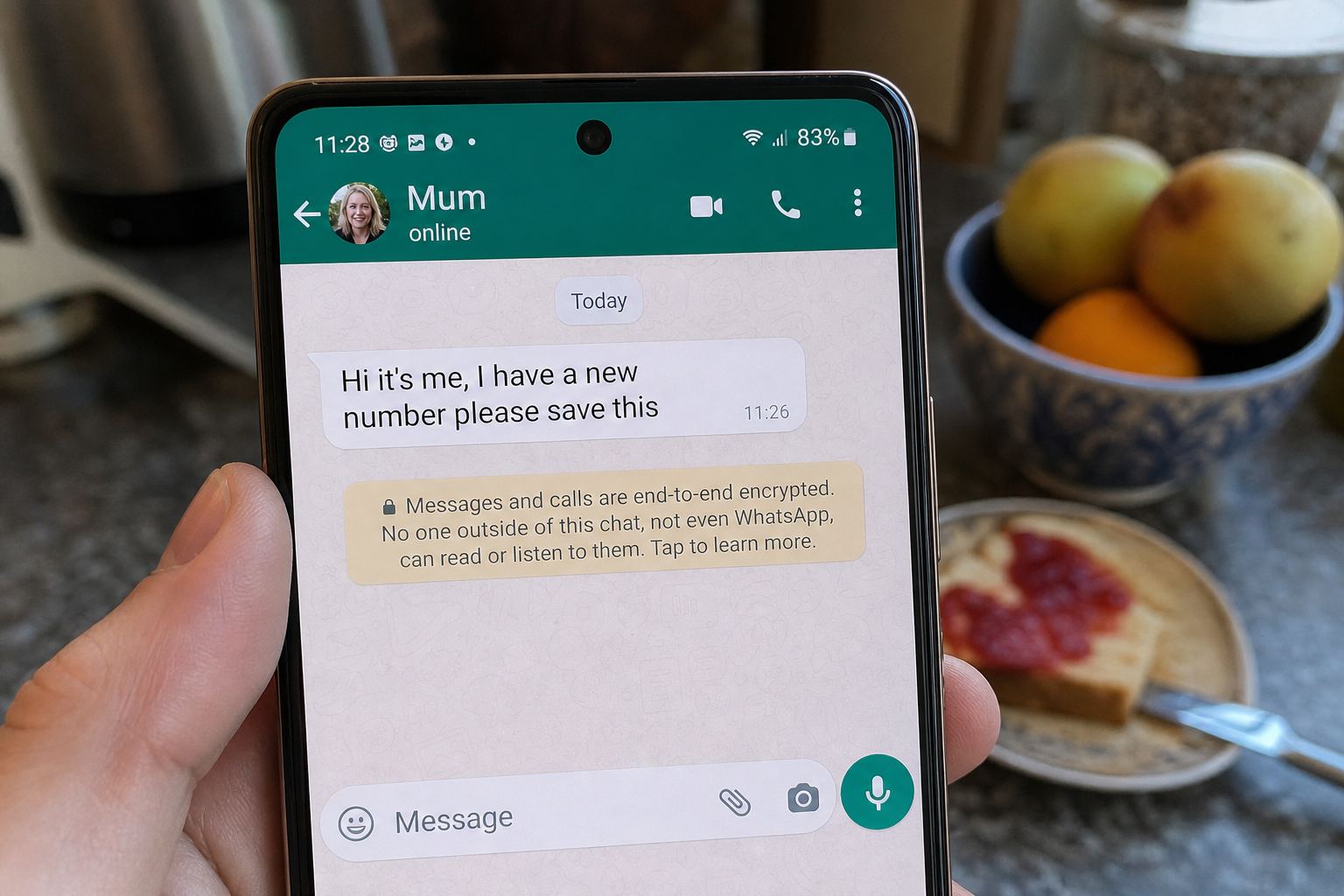
“Mum, I have a new number”
Updated 12 November 2026
The chat looks like family. The number is new. The story is a broken phone, a trip, a bill that must be paid today. What they want is a transfer, or a code that hands them your account. Scammers who pose as a relative on a new number are a long-running version of the family emergency scam: the FTC describes the pattern in its family emergency scams guide, and Australia's consumer regulator, the ACCC, warned in 2022 about "Hi Mum" messages that say a phone has been lost or damaged and a new number is being used (ACCC).
The old number wins
A real parent who changed phones will survive you calling the old number. A stranger will not. Do that before you argue in the new thread. If you cannot get through, try another relative or friend, and ask a personal question only the real person could answer. If voice is part of the panic, read voice cloning and set a safe word when nobody is crying.
What to do in the chat
Do not reply with money, gift card codes, bank details or any code that arrives by text. The FTC lists wire transfers, cryptocurrency, payment apps and gift cards as the payments scammers push because they are hard to reverse. You can block the number and report the chat to WhatsApp from inside the app, which is the quickest way to stop it. Keep a screenshot of the messages and the number before you block, in case you need to report.
If you shared a six-digit code
A code that WhatsApp texts you is for registering your number on a phone. If you read it out or typed it into a chat, someone else may be able to take over your own WhatsApp account, and then message your contacts as you. Re-register your number on your own phone so that you get back in, turn on two-step verification, and tell your contacts to ignore anything odd from your number. WhatsApp's security page says to set a secret PIN, never share it, and to re-register your phone number if you lose access, and the Help Center has the full steps for a hacked account. If your phone number itself is no longer working, contact your mobile carrier.
WhatsApp is not the only door
The same script arrives as iMessage, Telegram, or SMS. The rule does not change: check on a channel you already trust.
If money already left
Contact your bank or payment app straight away, using the number on your card or in the official app, and ask for the payment to be reversed. Then follow I paid a scammer, what now. In the US, report at reportfraud.ftc.gov and ic3.gov. In the UK, report to Report Fraud at reportfraud.police.uk or on 0300 123 2040 (in Scotland, call Police Scotland on 101), and forward scam texts to 7726. UK bank transfers through Faster Payments or CHAPS may be covered by the Payment Systems Regulator's reimbursement rules in force since 7 October 2024, with a standard limit of £85,000 (see the PSR announcement).
Quick answers
- They knew a family nickname.
- Names and nicknames can come from photos and old posts, or from an earlier hacked chat. A nickname is not proof.
- The profile photo is Mum's.
- A profile photo can be copied from anywhere. Look at the number, then call the old one.
- I already sent a code.
- If it was a six-digit WhatsApp code, someone may be able to take over your WhatsApp. Register your number again on your own phone, turn on two-step verification, and tell your contacts. WhatsApp's help pages for a hacked account have the steps.
This is general safety information, not legal advice. Scams change. If you need an official desk: FTC ReportFraud, IC3, or Report Fraud in the UK.