
Texts and calls
The Missed Court Date Text Scam, and What Real Courts Do
Updated 6 October 2026
You were in a meeting when the text arrived, and by the time you read it your stomach had already dropped. You have been told to appear, told to pay, told that a warrant is on the way, and the only thing between you and a contempt charge is a link you have never seen before. The expensive assumption is that a court can reach you by SMS, that a fine can be cleared by a screenshot, and that a link clicked in panic is safer than a letter opened later. None of that is true, and the cost of believing it is usually measured in four figures, taken from your account before you can breathe.
What the missed court date text actually says
The scam arrives as an SMS, sometimes a tap-to-load iMessage, from a number that looks local. The body of the message is short and uniform, and the uniformity is the point. You will see one of a handful of messages, recycled through different area codes, different sender IDs, and different fake department names.
The most common variants, in October 2026, read close to one of these:
"This is a final notice from the County Clerk's Office. A bench warrant has been issued for your failure to appear in case #__________________. Settle the outstanding balance of $__________________ by __________________ to avoid arrest. Confirm your appearance at the link below."
"You missed jury duty on 4 October. Failure to respond is a Class A misdemeanor under state code. Pay the $1,250 forfeiture to clear the case and lift the warrant now: [link]."
"State Judiciary Notification: Case No. CV-2026-_______. You have been named in a civil claim that will proceed without your response after 48 hours. Review the file and remit the filing fee at the link provided."
"Department of Justice. Your social security number has been used to open accounts in the state of Texas. A federal grand jury has issued a summons requiring your appearance in 72 hours. Do not discuss this matter. Pay the processing fee of $489.00 through the secure portal."
You can already feel the pull. The sender uses the language of a real court file. There is a case number, a code section, a class of offence, a fee, a deadline, and a link that looks like a government domain but resolves to a lookalike on a rented virtual host. Some of the more recent messages add a PDF attachment of what looks like a real summons, complete with a court seal lifted from a public PDF. The seal is decorative, not jurisdictional. The case number is invented. The link is the whole point.
Click the link and you land on a page styled as a state or federal portal. You are asked to confirm your name, your date of birth, the last four of your social, and then the "balance". You are offered Apple Pay, a bank transfer, or, the tell, payment in gift cards from a major retailer. The gift card field is the floor of the scam. No courthouse in the United States accepts a Target gift card as satisfaction of a bench warrant. None in the United Kingdom accepts an Ocado voucher to lift a contempt finding. The payment is the evidence that the message is fake, and the people who run the scam know it, which is why they want it before you talk to anyone.
How a real court contacts you, and what a real summons looks like
The reason these texts work is that most people have never seen a real court summons, and do not know what the system looks like from the other side. The system is slow, paper-heavy, and procedurally rigid, and those three qualities are the only protection you need.
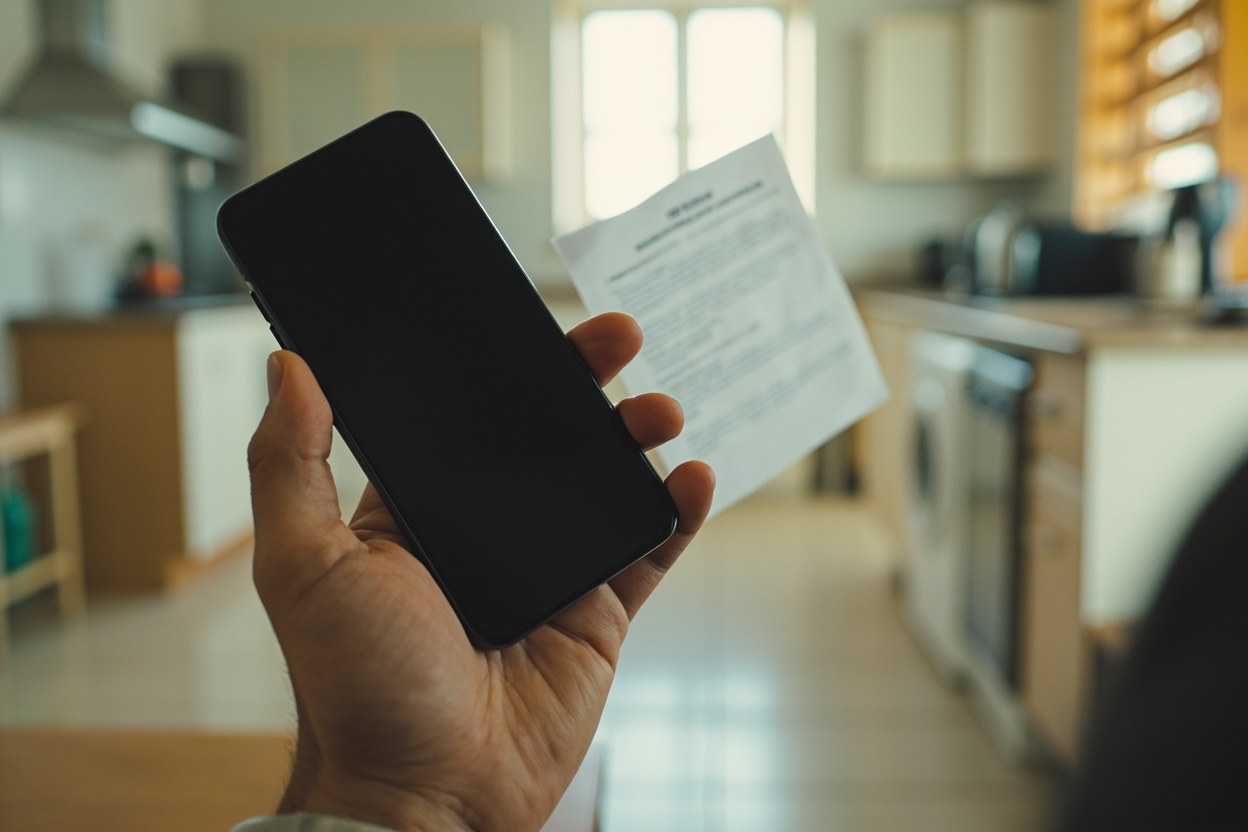
In the United States, a criminal summons or a civil notice is delivered by one of a small number of methods, and SMS is not on the list. A misdemeanor summons is normally hand-delivered by a process server or a sheriff's deputy, or sent by certified mail through the United States Postal Service. A federal grand jury summons is delivered in person by a federal officer. A civil claim is served by a process server or by certified mail under Rule 4 of the Federal Rules of Civil Procedure, or the equivalent state rule. The summons itself is a printed document on letterhead, bears the seal of the issuing court, names the parties and the case number, and gives a return date and a courtroom. It does not contain a link, a barcode, a QR code, or instructions to pay anyone online. If the document asks for payment, it tells you the court clerk's office, not a third-party portal.
If you genuinely failed to appear, the system does not run by text. The court will issue a bench warrant. That warrant is held by a court clerk or, in some jurisdictions, by a local police department. It is not mailed to you. It is not paid off remotely. If the warrant is enforced, you will know, because a deputy will be at your door. The warrant is not extinguished by a wire transfer. The forfeiture that the text demands does not exist as a category, and even where a state allows the waiver of a court appearance on a minor traffic matter, that waiver goes through the court clerk's office, by mail or in person, and is documented on the docket.
In England and Wales, a court summons is served either in person by a court bailiff or by first-class post to the address on file. A jury summons is posted, not texted. A fine is paid through the court fine account, by phone through a number printed on the back of the order, or by cheque. The HM Courts and Tribunals Service does not accept payment in gift cards, does not send SMS with payment links, and does not threaten a warrant as a way to collect a fine. A real fine carries a reference number, a court name, and a contact number you can call back on a line you have looked up yourself.
The principle is the same in both jurisdictions. A court is a public institution with a paper trail. It does not need a link in a text. It does not need you to act in fifteen minutes. It does not need to be paid in the currency of a coffee shop.
The fear the message is built to create
The missed court date text is engineered to manufacture a single emotion, the moment a person realises that a warrant might be outstanding and that the next knock on the door could be from a deputy. The scam works because the fear is reasonable, and the cost of being wrong feels higher than the cost of paying. A few hundred dollars wired through a CVS looks cheap against the imagined scene of a uniformed officer at the door, a handcuffed ride to county, a night in a holding cell, and a week of missed work while the case is sorted out. That is the calculation the sender is asking you to make, and the calculation is rigged.
The numbers reflect the design. The Federal Trade Commission logged more than 4.6 million reports of imposter scams in 2025, and government and business imposters were the two largest categories. A working paper from the University of Pennsylvania's Wharton School in March 2026 estimated that one in seven American adults received a court, warrant, or fine impersonation text in the previous twelve months, and that the median loss among those who paid was 480 US dollars. The Canadian Anti-Fraud Centre recorded a 312 percent year on year increase in warrant and fine related fraud reports in 2025, and the UK National Fraud Intelligence Bureau logged just over 38,000 Action Fraud reports tagged "legal impersonation" in the same year. Those are reported losses. The actual number is higher, because the embarrassment factor drives the report rate down.
The sender is not trying to reach people with a real case. The sender is trying to reach people who can be made to believe they have one, and the volume of the scam is tuned to the base rate. A spam run of a million messages costs almost nothing. If one in ten thousand recipients pays, the operation is profitable. If one in a hundred thousand pays, the operation is still profitable. The texts are short because long ones are filtered. They are uniform because the script is the funnel. The link is there because the link is the only way the money is taken.
How to handle the text without making it worse
The first thing to do is the thing the text is built to prevent. Do not click the link. Do not reply. Do not call the number in the message. The link is the trap. It either loads a credential harvester that captures your name, your date of birth, and the last four of your social security number, or it loads a payment page that takes a card and a one-time code and returns nothing. Replying confirms that your number is live, that you read the message, and that you are the kind of person who responds to legal threats by SMS. Your number is then sold, the script is refined, and the next message will be closer to the bone. Calling the number in the message takes you to a person who is prepared, who already knows the script, and who is the same kind of licensed as the link is a court. A real court does not run on a VoIP forward.
The second thing to do is verify from a clean line. Open a browser, type the address of the court yourself, and look up the case. Most US state courts run a public docket search by name or by case number. The federal courts run PACER, which is free for the first view of a document in any quarter. If the case number on the text exists, it will appear. If it does not exist, the message is fake, and you have just saved yourself the four hundred dollars. If the message claims to be from a county clerk, call the clerk's office using the number printed in the local government section of the phone book, not the number in the text, and ask whether anything is open in your name. The clerk's office is a public counter. They will tell you.
The third thing to do is preserve the evidence. Take a screenshot of the message, including the sender number, the full body, and any link. Save the original. Then delete the message from your inbox. Screenshot the conversation and the metadata, not the link, and forward the original to 7726 in the United States, which is the GSMA spam reporting short code, and to report@actionfraud.police.uk in the United Kingdom, and to the Canadian Anti-Fraud Centre through its online portal. In the United States, you can also report the message to the FTC at reportfraud.ftc.gov, and to the FBI's Internet Crime Complaint Center at ic3.gov. Reporting is the only thing that improves the next wave, because the carriers and the platforms use the reports to take down the lookalike domains and the rented hosts.
If you already clicked the link, the damage is bounded but real. Run a malware scan on the device. Change the password on any account you signed into from the link. If you entered the last four of your social security number, freeze your credit at all three US bureaus, Equifax, Experian, and TransUnion, and set up a my Social Security account at ssa.gov so that nobody else can open one in your name. If you paid, call your bank or card issuer immediately, ask for a recall on the wire, and file a police report in the jurisdiction where the text was received. The police report is the document your bank asks for when it considers a chargeback, and it is the document the FTC asks for when it tries to recover the money. The recovery rate on these scams is low, but it is not zero, and the only recoveries the agency has are the ones it is told about.
Why the small amount is the point, and what to look for next
Some of the missed court date texts now arrive with a small amount, in the two to three hundred dollar range, on the theory that a small amount is easier to send without thinking. The smaller amount is also easier to dispute through a bank app, which is exactly what the sender wants. A small payment through Apple Pay or a debit card is hard to recover, easy to send, and almost never investigated past the first contact with the bank. The text also sometimes asks the recipient to take a photo of the back of a gift card and to send the photo to a number. The photo is the proof of payment, and the photo is what gets sold on.
The pattern is not going to soften. The Federal Communications Commission moved in August 2026 to require the carriers to implement a richer set of call and text authentication checks, including stronger caller ID for SMS, and the major US carriers have committed to a phased rollout through the end of 2026. The rules will help. They will not stop the next wave. The next wave is already being written. The scripts are translated. The domains are pre-registered. The lookalike pages are templated. The court seals are lifted from public PDFs and dropped onto images that are then stripped of the metadata that would let you trace the lift. The technology is not the long pole. The long pole is the human moment, the moment the text is read, the moment the fear spikes, and the moment the link is tapped before the brain catches up. The only durable fix is a habit, and the habit is to put the phone down and verify from a clean line. The cost of a forty minute verification is the cost of not paying four hundred dollars. The cost of not verifying is the cost of paying it and not getting it back.
You do not need to live with the fear on your lock screen. You do not need to take a screen-grab of the message to sleep. The right move is to take a screen-grab, delete the text, and check the docket on your own time. If a real case is open, the docket will say so. If the docket is empty, the text is fake, the warrant is fake, and the case number is a piece of fiction designed to part you from your money before you call your mother. The court that wants you will write to you. The court that wants to fine you will tell you in person. The court that wants your gift card is not a court.
Quick answers
- Can a real court really text me about a missed date?
- No. In the US and the UK a court summons is hand delivered, served in person, or sent by certified mail, never by SMS with a payment link.
- What if the case number on the text is real?
- Look the number up on the public docket of the court named in the message, not the court named in the link. Real case numbers appear on the docket under your name. Fake ones do not.
- I already paid a gift card to clear a warrant. Is there any way to get the money back?
- File a police report in your home jurisdiction and submit it to the FTC at reportfraud.ftc.gov and the FBI's IC3. Recovery is low but a chargeback is more likely with a report than without one.
- How do I tell a real jury summons from a text?
- A real jury summons is mailed on court letterhead with a date, a juror number, and a phone number you can verify on the court website. It does not include a link, a QR code, or a payment field.
- Will forwarding the text to 7726 actually do anything?
- Yes. 7726 is the GSMA spam short code used by the major US carriers. Forwarded messages feed the carriers' filters and help the platforms take down the lookalike domains.
This is general safety information, not legal advice. Scams change. If you need an official desk: FTC ReportFraud or IC3.