Texts and calls
The grandparent scam call, and what voice cloning changed
Updated 6 September 2026
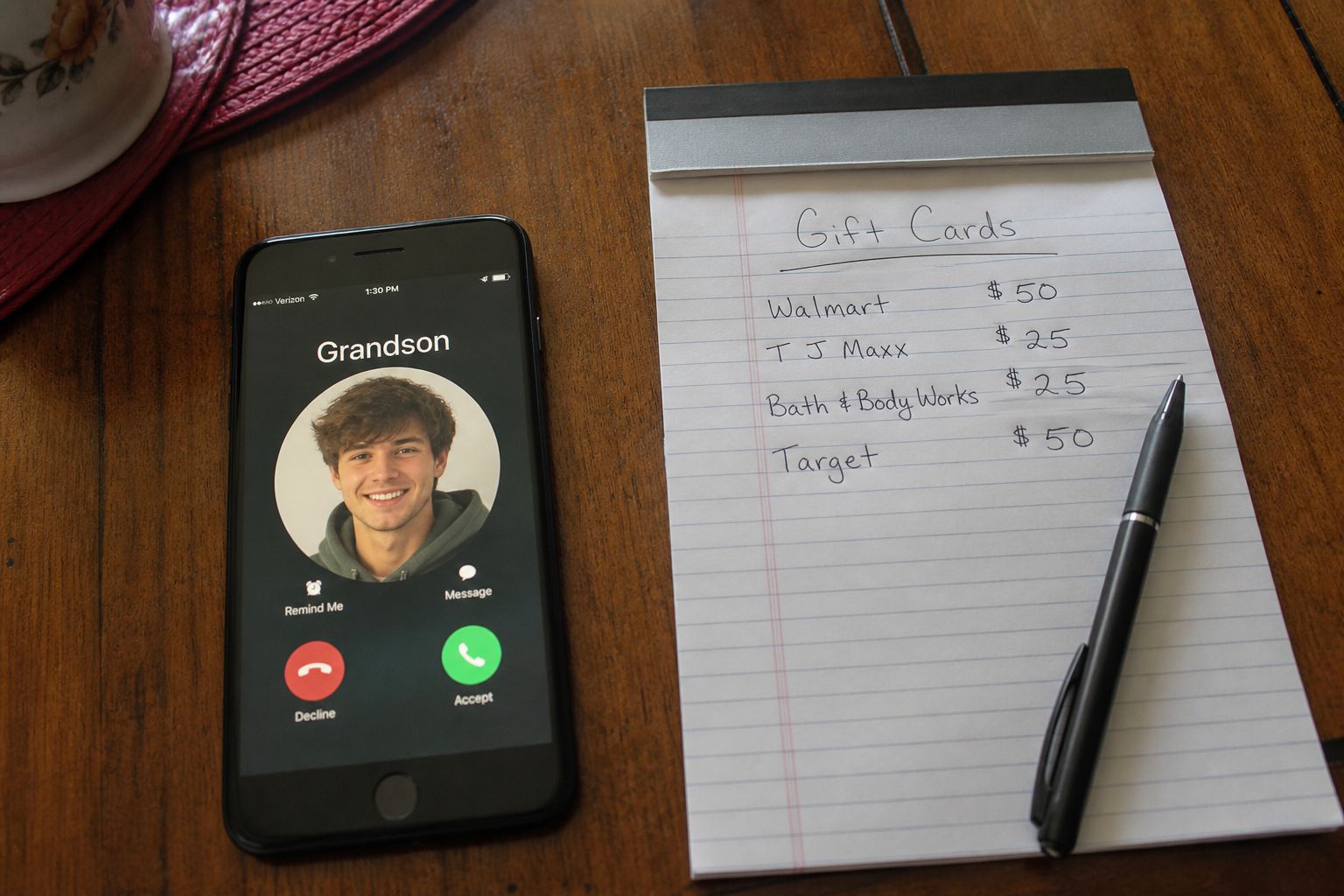
"Grandma? It's me." That's the opening, and most people answer it by saying a name out loud. From that second on, the name belongs to the caller. So when a grandchild calls in trouble and needs money right now, hang up and call that person back on the number already saved in your phone. Do it even if the voice sounds exactly right. That one habit beats nearly every version of this scam, and it costs you about thirty seconds.
- 1Caller has you say a name first, then claims to be that person
- 2A second caller poses as a lawyer or bail bondsman mid-call
- 3Told to stay silent because of a court 'gag order'
- 4A courier is sent to collect cash in person, real courts never do that
The grandparent scam has run in roughly the same shape since the mid-2000s. Two things changed recently. The voice on the phone can now be a synthetic copy of the real person's voice, and the money increasingly gets collected in cash by a courier who drives to the house.
The script, more or less word for word
It opens with a sob, a cough, or a mumble, then a question that makes you do the work: "Grandma? It's me." Most people fill in a name out loud. That name belongs to the caller for the rest of the conversation.
Next comes a reason the voice sounds off. A car wreck. A broken nose. Dental work after the crash. Then an arrest, usually for something embarrassing rather than violent, like a DUI or a collision where someone else got hurt. Then the handoff: a second person takes the phone and introduces himself as a public defender, an attorney, or a bail bondsman, and he's organized and calm in a way the crying grandchild is not.
Two lines do most of the damage. One asks for secrecy, usually some version of "please don't tell Mom and Dad." The other dresses secrecy up as law. In a federal indictment out of the Southern District of California, prosecutors described a caller who "warned JD not to discuss this with anyone or risk violating a court gag order." Canadian and US cases describe the same move, with seniors told a judge had imposed a gag order on the case.
That's the whole engine. The gag order isolates the target from the one relative who would have said "hang on, let me call him."
What voice cloning changed, and what it didn't
The FBI's December 2024 public service announcement on criminal use of generative AI describes the tactic directly. Criminals "generate short audio clips containing a loved one's voice to impersonate a close relative in a crisis situation, asking for immediate financial assistance or demanding a ransom." Consumer Reports tested six consumer voice cloning products in March 2025 and found that four of them "erected no meaningful barriers to cloning someone's voice without their consent." A voicemail greeting, a wedding toast, or a few seconds of a public video is enough source material for the better tools.
So the old tip about listening for a flat, robotic delivery is weak advice now. I'd retire it.
Here's the part the headlines usually skip. Most of these calls still involve no AI at all. The classic version works fine, because the caller gets you to supply the name yourself and then blames the odd voice on a broken nose. Cloning raises the ceiling on how convincing a call can get, but it didn't create the problem, and your defense is identical either way: verify on a channel the caller doesn't control. If you want the mechanics, we go through them in more detail on how AI voice clone scams are put together.
The courier at the door
The cash pickup is the escalation worth knowing about, because it's the part people don't expect. Wires get flagged. Gift cards leave a paper trail and cashiers now ask questions. Cash handed to a stranger on your porch does neither.
Federal prosecutions describe it plainly. In a Western District of Wisconsin case, "victims were told their relative had been arrested" and then "victims were asked to provide bail money in cash," collected by couriers posing as bail bondsmen. In the San Diego indictment, the sequence is one sentence: "A courier went to JD's address and picked up the cash." Rhode Island prosecutors have charged and sentenced multiple couriers, including three men who took more than a dozen local seniors between the ages of seventy-nine and ninety-four for more than $300,000, and a New York man ordered to repay over $750,000 after traveling around the country collecting envelopes from older people.
Couriers are usually the bottom rung. Some get recruited through fake "package pickup" job listings and genuinely don't know what's in the envelope. That doesn't help you, and it doesn't make the money recoverable. Packaging instructions vary a lot between cases, so I wouldn't rely on any single description of what the caller tells you to do with the cash.
While the caller is still on the line
- Hang up. Don't stay on the line while you go get money, and don't call any number the caller gives you.
- Call back on a number you already have. If there's no answer, call that person's parent, sibling, or roommate. Someone will know where they are.
- Ask for the safe word. The FBI's own recommendation is to "create a secret word or phrase with your family to verify their identity." Our family safe word generator picks one that's easy to say under stress and hard to guess from a Facebook profile.
- Or ask something a stranger couldn't know. Not your mother's maiden name. Something like the name of the dog you had before this one, or what you ordered the last time you ate together.
- Refuse the in-person handoff outright. No court sends someone to your house to collect bail. Bail gets posted at a courthouse or a licensed bondsman's office, and no lawyer needs $9,000 in an envelope before 4pm. The same fake-bail pitch turns up when a supposed deputy says the warrant is for you, which is the jury duty and arrest warrant scam.
If a pickup is already arranged
Don't open the door and don't hand anything over. Call your local police on the non-emergency line and say a courier is expected to collect cash for a scam; departments in a lot of states have worked exactly this and some have made arrests at the door. Skip the idea of confronting or filming the person yourself.
If money already left, act by method. Cash is generally gone. A wire might be recallable if you call the bank inside the first hours, so call, don't email. Report at reportfraud.ftc.gov and at ic3.gov, and call the Justice Department's National Elder Fraud Hotline at 833-372-8311, open Monday through Friday, 10am to 6pm Eastern, where case managers walk you through federal, state, and local reporting instead of leaving you to figure it out.
Raising this with a parent without sounding like you're taking the car keys
Talk about the criminals' technique, not about who falls for things. A conversation about how the gag order line works is interesting. A conversation about how seniors get targeted is insulting, and people stop listening around sentence two.
Set the safe word up as a family rule that binds everyone, including you and your kids. Frame the callback habit the same way: nobody in this family ever asks for money by phone, and everyone always hangs up and calls back, no exceptions, no hurt feelings. That way the rule isn't about anyone's competence. It's just how the family works.
Skip any offer to monitor their accounts. That's usually where the conversation dies, because it turns a shared problem into a supervision arrangement. The FTC's Pass It On program takes the better approach, handing older adults material to warn other people rather than lecturing them, and the printed packets are free at consumer.ftc.gov/features/pass-it.
Say one more thing out loud, once: if it ever does happen, tell me and I won't be weird about it. Shame is why the official numbers are undercounts. The FTC recorded $15.9 billion in reported fraud losses in 2025, up from $12.5 billion in 2024, and the FBI's 2025 internet crime figures put losses reported by people 60 and older near $7.7 billion, with roughly $893 million tied to AI-enabled schemes including family-in-distress calls. The real totals are higher, because most people never file anything.
The same age group gets worked from quieter angles too, so if your parent is on Medicare, spend five minutes on the calls about Medicare cards and benefits, which don't feel like an emergency at all and are much easier to miss. Then give your mother one sentence, in plain words, next time you've got her on the phone: if anyone ever rings you saying I'm hurt or arrested or in a cell somewhere, hang up on them and call me, and I will never be annoyed that you didn't believe them. She'll remember that longer than she'll remember any of the rest of this.
Quick answers
- The voice sounded exactly like them.
- That is the point of a clone. The callback is the test.
- I already sent a card.
- Call the card desk with the receipts, then read I paid.
This is general safety information, not legal advice. Scams change. If you need an official desk: FTC ReportFraud or IC3.