Texts and calls
The USPS redelivery fee text scam, and why the tiny amount is the point
Updated 6 September 2026
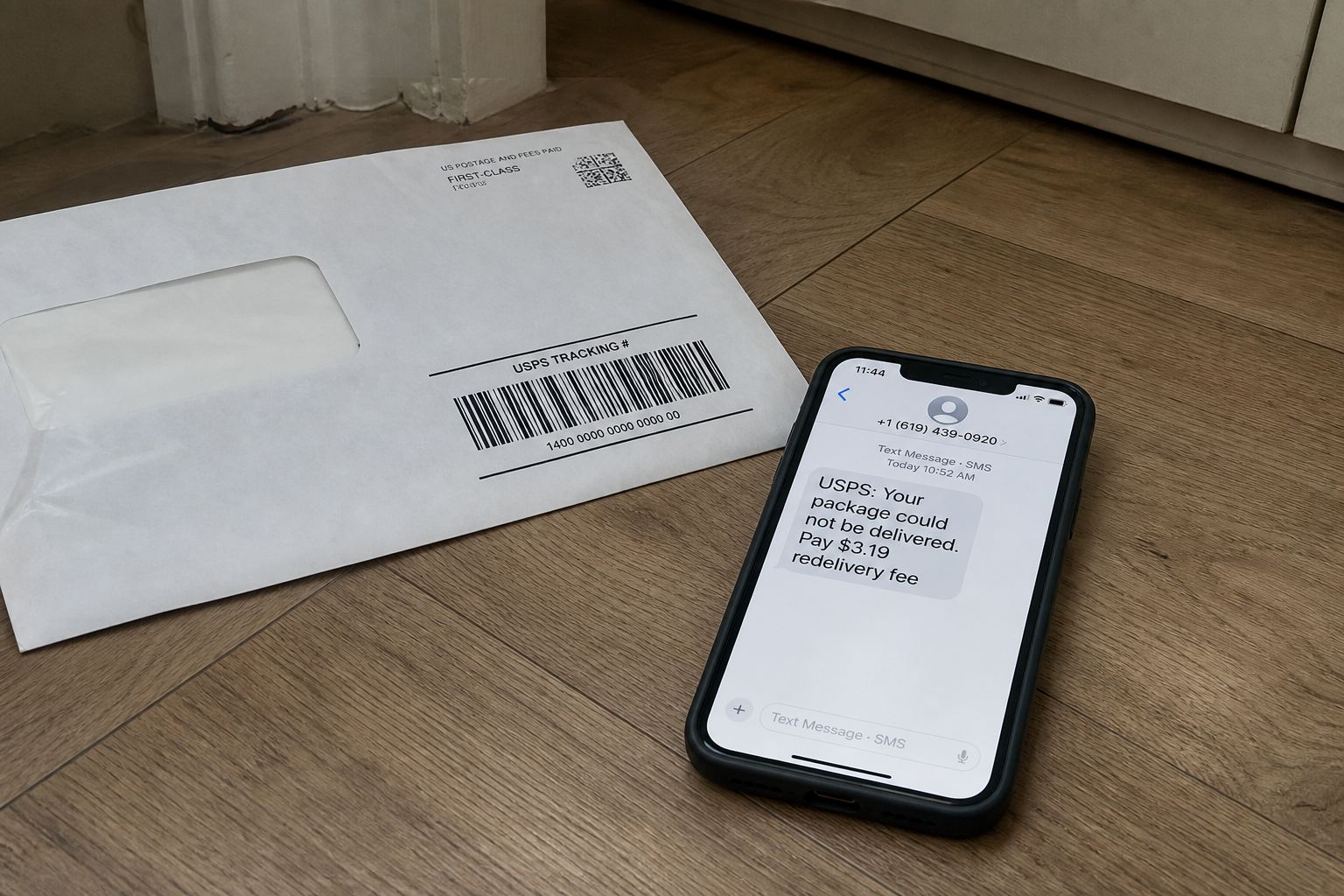
$470 million. That's what the FTC counted as lost to text scams in 2024, with fake package delivery the single most reported category of the lot. The USPS redelivery fee text is the workhorse version of it, and it's a scam. USPS doesn't charge you to redeliver a package, and it won't send you an unrequested text with a link in it. The fee is deliberately small, because the money was never the thing they were after.
- 1usps-pkg-redeliver.com is a reported lookalike domain, not usps.com
- 2USPS never charges a redelivery or postage fee, let alone by text
- 3The 12-hour deadline is designed to rush you before you check
- 4$2.99 is deliberately tiny so you pay without a second thought
The amounts land in a narrow band. Thirty cents. $1.99. $2.99. $4.96. One documented version leads with "Unpaid Postage Notice: $2.99 Required" and then the line "Your shipment cannot be delivered until the outstanding postage fee is paid." Less than a coffee. That's the design, not an accident.
The lookalike domains, and the reply Y line
The wording changes constantly but the skeleton doesn't: a tracking number, a claim that delivery failed or postage came up short, a deadline (12 hours, 24 hours, "or your parcel will be returned to sender"), and a link. Reported domains include usps-reschedule.net, usps-pkg-redeliver.com, and usps.informedtrck.com. Look at the pattern there. The letters u, s, p and s show up somewhere in the string, but the registered domain isn't usps.com.
One newer wrinkle is worth knowing about. iPhones disable links in messages from senders who aren't in your contacts, so a lot of these texts now include a line like "Please reply Y, then exit the text message, reopen the text message activation link." Replying switches the link back on. Years of appointment reminders trained you to fire off a one-letter reply without thinking, and the crews running this know it.
Why a small amount works better than a big one
Two reasons, and neither of them is the fee.
The first is resistance. A $1.99 charge doesn't feel like a decision at all. You'd interrogate a $180 customs bill. You won't interrogate the price of a pack of gum, especially at 9pm on your phone while you're half-watching something else.
The second reason matters more. That payment page is the harvest. What it wants is the card number, the expiry, the CVV and the billing address, all of which you type calmly precisely because the amount is trivial. Then comes the screen that actually does the damage: a box asking for the one-time code your bank just sent you.
Here's what that code often does. Reporting by Krebs on Security in February 2025 documented how these groups take the card details you just typed and immediately try to enroll the card in Apple Pay or Google Wallet on a phone they control. Your bank sends a verification code for that enrollment. The phishing page tells you it's confirming your $1.99 charge. Hand it over and your card now sits in a stranger's mobile wallet, usable for tap-to-pay fraud, still working long after you noticed the $1.99 and shrugged.
AARP's fraud helpline has described a caller who paid 99 cents on a page like this and later found a $400 charge. That's the honest version of the risk. The visible amount tells you nothing about the eventual amount.
The Postal Inspection Service policy, in one sentence
The Postal Inspection Service states its policy in one sentence: USPS will not send customers text messages or e-mails without a customer first requesting the service with a tracking number, and it will not contain a link. Free service, no fee, no link. That single sentence disposes of essentially every version of this text.
If you want real text updates, you start them yourself, either by texting a tracking number to 28777 (which spells 2USPS) or by opting in on the tracking page at usps.com. Texting STOP to 28777 turns them off again. Redelivery itself is free and gets scheduled at tools.usps.com/redelivery.htm, which you should reach by typing it, not by tapping anything.
When a carrier genuinely can't leave something, you get paper. PS Form 3849, titled "We ReDeliver for You!", is the peach-colored slip in your box (yellow for Sunday deliveries). Since a 2022 redesign it carries a QR code, which is an awkward fact, because a printed QR code on a delivery notice is also something a scammer can fake and tape to a door. If one shows up and you're unsure, you can decode a QR code from a photo and see where it leads before you go anywhere near it.
There is exactly one common situation where USPS really does collect money from you at delivery: customs duty on inbound international mail. That arrives with CBP Form 3419ALT in an orange adhesive envelope stuck to the package, and you pay the carrier at the door or at the post office counter. Never through a texted link.
The tracking number check, and its limits
Standard USPS Tracking numbers are long, usually 20 to 22 digits, and Priority Mail numbers commonly begin 92, 93 or 94. A short string, or something with letters bolted onto the front, is a reasonable tell.
Don't lean on it too hard, though. Plenty of these texts now paste in a plausible-looking number, and some use numbers lifted from real shipments. The move that always works is to copy the number and type it into usps.com yourself. If a package exists, you'll see it. If the site returns nothing, you have your answer, and you got it without touching their link.
Reporting it, which genuinely takes two minutes
Postal inspectors want these, and they're specific about the format. Without clicking anything, copy the body of the text and paste it into a new email to spam@uspis.gov. Include your name in that email. Attach a screenshot of the message showing the sender's phone number and the date it was sent. If you clicked, paid, or entered any information, say so, because it changes how the report gets handled.
Forward the message to 7726 as well, which routes it to your mobile carrier's spam team. File it at ReportFraud.ftc.gov. If money actually moved, add a complaint at ic3.gov. USPIS also takes reports by phone at 877-876-2455. What you shouldn't do is reply "STOP" to the original text, since on a scam number that only confirms a human reads that line.
For scale: the FTC found fake package delivery was the single most reported category of text scam in 2024, with $470 million lost across all text scams that year and a median loss of $1,000. You're not being paranoid, and you're definitely not the only one getting these.
If you already paid
Call your bank on the number printed on the card, not a number from the text and not a number from any call that arrives afterward. Ask for two things: dispute the charge, and check whether your card has recently been added to a mobile wallet. Reissuing the card number is usually the right call rather than watching and waiting.
Then expect a follow-up. A day or two later somebody calls claiming to be your bank's fraud department, already knowing the merchant and the amount, because it's the same operation working the second act. Voice cloning has made that call much harder to dismiss on instinct, so it helps to know how AI voice clone scams are actually run before one lands. And if you reached the fake page by scanning a code rather than tapping a link, the cleanup order shifts slightly; that's laid out in what to do after scanning a scam QR code.
There's a sibling version of this message. It drops the fee completely and claims the driver just needs your address confirmed, which sounds far more reasonable and comes from the same operation. That one's picked apart in the delivery driver address confirmation text.
Quick answers
- Informed Delivery is real, right?
- Yes — inside the USPS account, not a random SMS.
- I paid $3.
- Call the card. The fee was the test.
This is general safety information, not legal advice. Scams change. If you need an official desk: FTC ReportFraud or IC3.