Texts and calls
Task scams: the "get paid to like videos" job that eats your savings
Updated 6 September 2026
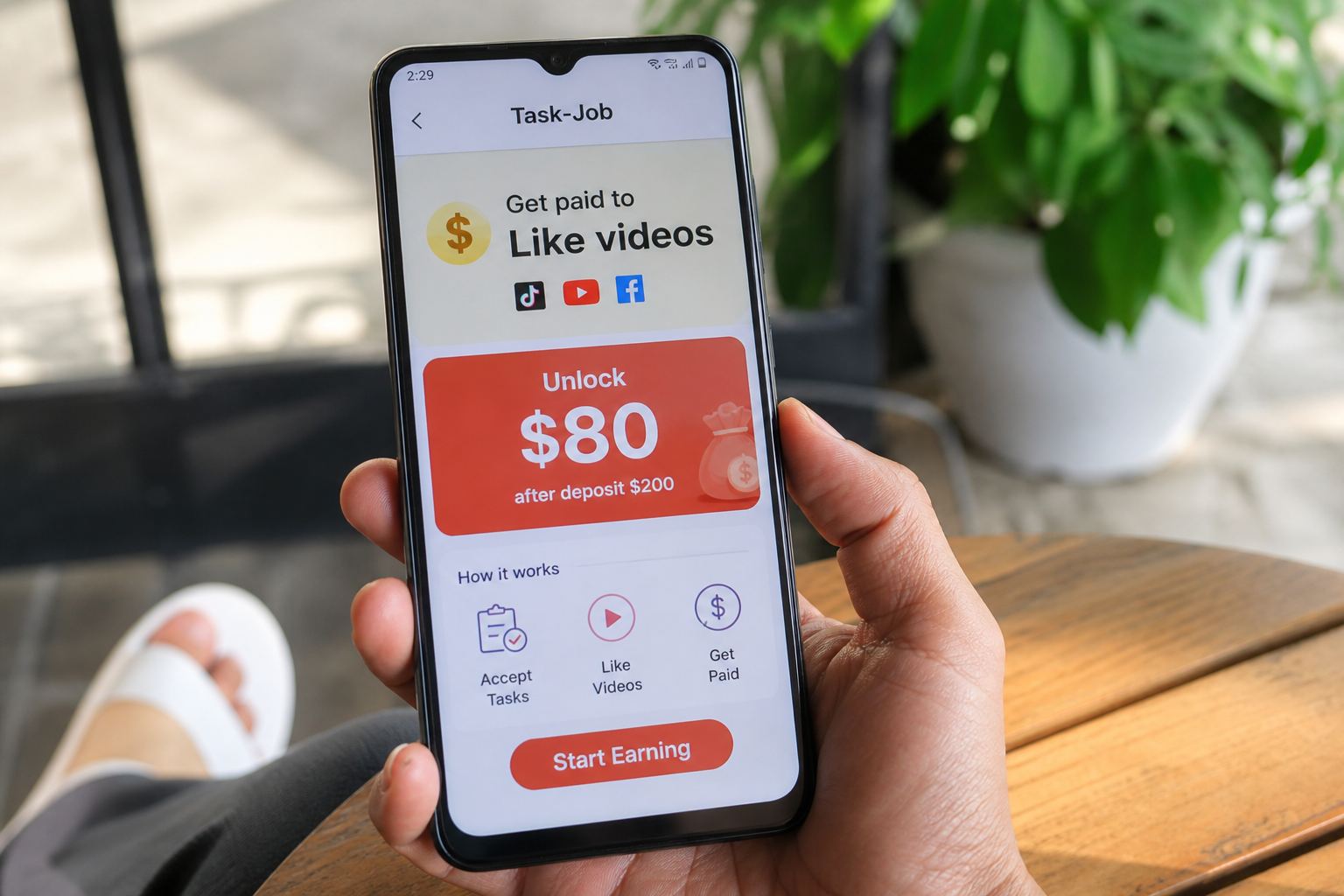
The phone is face-up on the kitchen table, dashboard still open, balance reading $48 after an evening of liking videos. You tap withdraw, and a box appears asking you to deposit your own money first. That box is the entire scam. A task scam is a fake job that pays you a little, then gets you to pay it all back and more: trivial online work (liking videos, rating hotels, clicking "boost" on product listings), a balance that climbs, and then a wall you can only pass by sending money. The number on that screen is a row in someone else's database. Your deposit is real, and it's usually in crypto, which means it's gone.
The opening text, and the vocabulary that keeps repeating
It arrives as a text or a WhatsApp message from a number you don't know. Sometimes it opens with a friendly apology for the interruption. One documented example from August 2025 claimed to be from Indeed, said it was "recruiting remote product testers" in the US, and promised $50 to $400 a day for 60 to 120 minutes of work.
The vocabulary is remarkably consistent. You'll see "app optimization," "product boosting," "data optimization," "no experience needed," and "daily salary." Reply, and the conversation moves fast to WhatsApp or Telegram, where a recruiter with a plausible Western first name takes over. The Better Business Bureau's 2026 employment scams update logged recurring aliases including "Goldie" and "Rebecca Harris." Some setups start with a QR code you're told to scan to join the team group chat. If that happens, you can decode the QR code without scanning it and see the actual destination first.
Why the first payouts are real
They are. That's the part people don't believe until it happens to them. You'll complete a set of tasks, see $20 or $48 credited, request a withdrawal, and the money lands in your account or wallet. Sometimes twice. Sometimes three times.
That's the entire investment the scammer is making in you, and it works because it converts a stranger's promise into a verified fact. The FTC's December 2024 Data Spotlight called this structure a gamified job scam and compared its psychology to gambling: variable rewards, a progress bar, a level to reach. Once you've withdrawn real money once, the platform stops being a website and starts being your employer.
The deposit-to-continue mechanic
Then the tasks change. A "combination task" or "merchant task" appears, worth far more than the others, and completing it drives your account balance negative. To finish the set and collect the larger commission, you have to top the account up yourself.
The first ask is small on purpose. In the case reported by Slate, it was $18 in Bitcoin, then $79, then $350 to fix a supposed account problem, roughly $96 net across two months for that particular writer. Others do not get off that lightly. There's always one more step: a verification fee, a withdrawal tax, an anti money laundering deposit, a credit score upgrade. Each one is framed as the last thing standing between you and a balance that never existed.
Why it's always crypto
Because there's no chargeback. A wire can sometimes be recalled, a card payment can be disputed, and a bank has a fraud department that answers the phone. USDT sent to a wallet address does none of that. The FTC found crypto losses to job scams hit $41 million in the first half of 2024 alone, nearly double the total reported for all of 2023.
Some victims are walked to a crypto ATM and coached through the screens. If a "recruiter" is on the phone telling you which buttons to press at a machine in a gas station, that's not onboarding, that's the theft happening in real time.
How big this actually is
Task scams barely existed in 2020. The FTC counted about 5,000 reports in 2023 and roughly 20,000 in the first half of 2024, which was close to 40 percent of all job scam reports that period. Total job scam losses passed $220 million in those same six months.
The typical loss is smaller than the headlines suggest. BBB Scam Tracker's 2026 update put the median task scam loss at about $2,300. That's not nothing, but it's not the $140,000 outlier case that gets written up, and if you're sitting there having lost a few hundred dollars, you are the normal case, not the cautionary tale. All of these numbers are also floors rather than ceilings, since most people never report at all.
Why it lands hardest on people who need the money
This scam is aimed precisely at anyone who needs flexible income now. BBB's data points to higher risk among people aged 19 to 29 and among Black and Latino jobseekers. The offer is designed to sound plausible to someone caring for a relative, recovering from a layoff, working around a disability, or piecing together hours between shifts.
And here's the part that gets left out. Many of the people typing those messages are not choosing to. Reporting from June 2026 estimated more than 5,300 people were still held in scam compounds along the Myanmar border after last year's crackdowns, with tens of thousands trafficked into similar operations across Myanmar, Cambodia and Laos. The person who called you "dear" for three weeks may be locked in a building. That doesn't get your money back, but it should end any private theory that you were singled out for being gullible.
The tests that settle it in under a minute
- Real employers don't cold-text strangers about jobs. Not Indeed, not Amazon, not Netflix. Recruiting happens through applications you submitted.
- You never pay to get paid. No legitimate job requires a deposit, a training fee, or crypto to release wages you've already earned.
- A dashboard balance is not money. If the only place your earnings exist is inside their app, they're a graphic.
- Watch for the withdrawal wall. A fee, tax, or "account upgrade" demanded at withdrawal time is the scam's signature, and it appears in nearly every version.
- Search the company name plus the word scam before you send anything. It costs ten seconds.
If you've already deposited
Stop paying. That's the whole first step, and it's harder than it sounds, because the sunk cost pulls hard and the "manager" will tell you one more payment releases everything. It won't.
Then move fast, because speed genuinely matters with crypto tracing. File with the FBI at ic3.gov and the FTC at reportfraud.ftc.gov, including every wallet address, transaction hash, phone number, and screenshot you have. Contact the exchange you bought through and give them the receiving addresses, since exchanges and stablecoin issuers can and do freeze flagged funds. If you paid by card or bank transfer at any point, call your bank the same day and use the words "fraud" and "unauthorized."
Ignore anyone who contacts you afterward offering to recover your funds for a fee. The FBI logged more than 10,500 recovery scam complaints in a single year with about $1.4 billion in losses attached. That's a second robbery aimed at people who already lost once.
If the scam started with a scanned code or a downloaded app, work through the cleanup steps for what to do after scanning a scam QR code, since credential theft and device permissions are a separate problem from the money. And if the original approach was a recruiter text rather than a task platform, the related pattern is covered in unsolicited job offer texts and fake interviews, which ends in stolen identity documents rather than crypto deposits.
People who fall for this are not stupid. The mechanism was built by professionals to defeat exactly the checks a careful person would run, and it defeats them by paying you real money first. Which is why the usual warning is shaped wrong. If you've got a kid picking up gig work between shifts, or a partner scrolling listings after a layoff, don't tell them to watch out for scams. Tell them this, in these words: if a job pays you before you've properly been hired, the payment is the bait, and the ask is coming right behind it. Say it tonight, and it'll be sitting there waiting when the $20 lands.
Quick answers
- The first tasks paid.
- That is how they get you to send a larger amount.
- They are in WhatsApp.
- Same script.
This is general safety information, not legal advice. Scams change. If you need an official desk: FTC ReportFraud or IC3.