QR codes
Are restaurant menu QR codes safe? Mostly, with two exceptions
Updated 6 September 2026
Most people have absorbed the idea that scanning a menu code can put something nasty on their phone. That isn't how any of this works. The code is a link to a web page, it can't install anything by itself, and the odds that a stranger stickered your table are low. Two real risks do exist here. Only one of them is a scam. The other is that the menu platform collects more about you than the restaurant ever would have.
I want to be straight about this, because the coverage has gotten silly. Headlines about criminals hijacking menu codes usually trace back to the same 2022 FBI advisory, which listed restaurants alongside parking meters and cryptocurrency ATMs as places where codes get tampered with. That advisory is real. But when I went looking for confirmed US menu tampering cases with a city, a count, and a sticker somebody actually removed, I kept landing on parking meters and EV chargers instead.
What a QR code can and can't do
A QR code is a printed string of text. In practice that text is a URL, and your phone offers to open it. That's the whole mechanism. It can't run code on its own, it can't read your contacts, and it can't install an app unless you tap through an installer and approve it.
So the risk is never the square. It's where the link goes and what you type once you're there. That reframing does most of the work here. A page that just shows you the pasta list has almost no attack surface, because you aren't entering anything into it.
Risk one: someone stuck a code over the real one
This is the scam version, and it's the same trick used on meters. Someone prints a vinyl sticker and puts it over the legitimate code. You scan, you land on a lookalike ordering or payment page, and you type your card number into it.
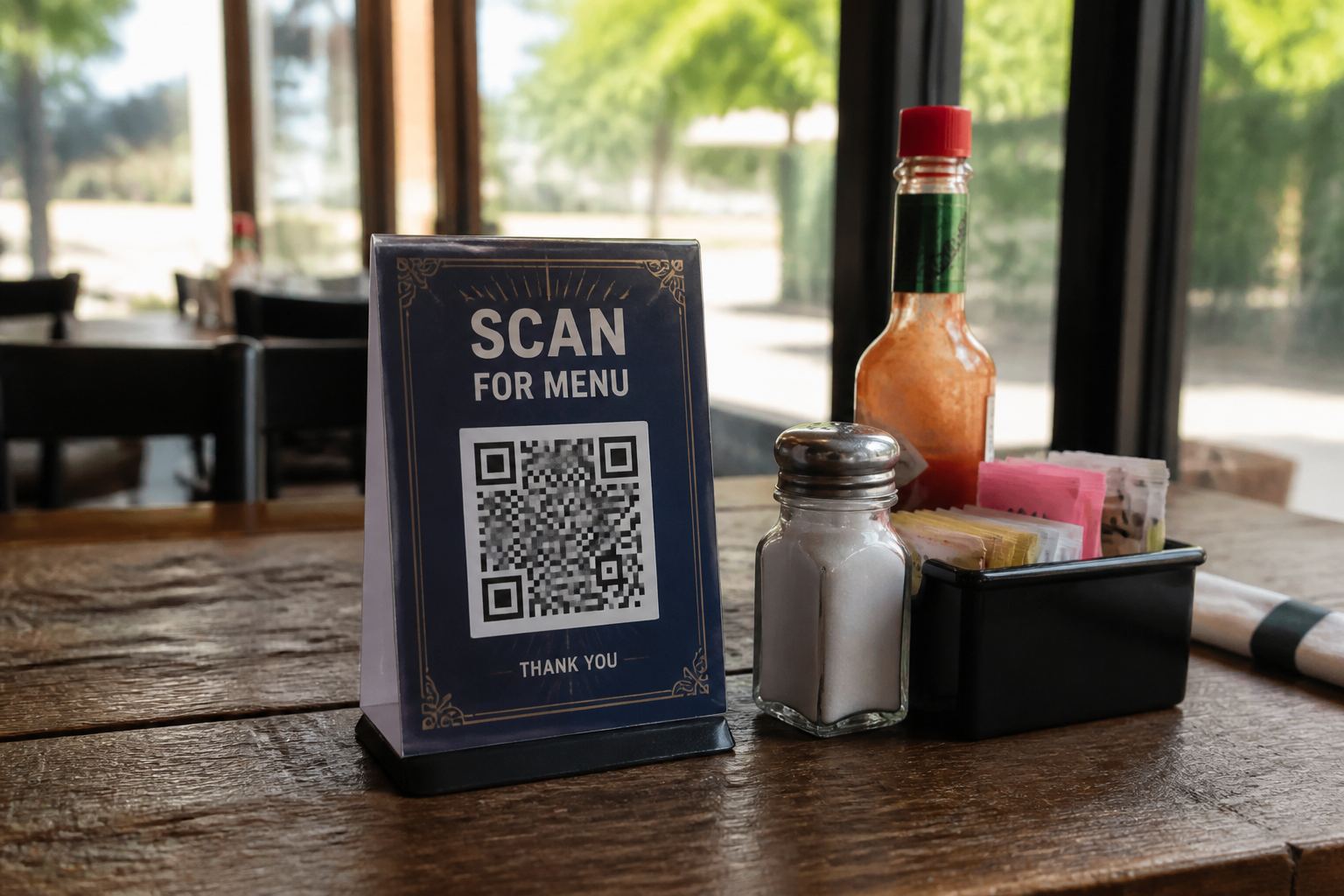
Check it the way you'd check a meter. Is the code printed directly onto the table tent, the placard or the menu card, or is it a sticker sitting on top? Feel the edge with a fingernail. A lifting corner, an air bubble, mismatched paper white, or a plain square label covering part of the original design all mean stop. That physical check beats anything you can do on your phone.
Two things make a restaurant table a worse target than a meter, which is probably why the confirmed cases cluster around meters. A menu code doesn't take payment, so a scammer has to build a convincing ordering flow before any money moves. And a table gets wiped, reset and looked at by staff a dozen times a day, while a meter stands alone on a street at three in the morning. Our page on fake QR stickers on parking meters goes through those cases, including the roughly 150 stickered meters found in Redondo Beach in 2024 and the Raleigh and Asheville incidents in early 2026.
Where restaurants do get interesting is pay-at-table. A code printed on your actual check, generated for that ticket, is hard to fake because it didn't exist an hour ago. A permanent "scan to pay your tab" placard glued to the table is a softer target. So is a "tip your server" code taped to a counter. If you're being asked to pay rather than read, look harder.
If a code makes you uneasy but you'd still like the menu, photograph it and run it through our QR code checker, which decodes the picture in your browser and shows the destination as plain text before you commit. On an iPhone you can also just hold the camera over the code without tapping. The yellow banner shows the domain, and pressing and holding it gives you the full link with the option to copy rather than open.
Risk two: the menu platform, which nobody warns you about
This one is routine, and it's why I'd rather have paper. The restaurant rarely builds its own menu page. It pays a digital menu vendor, and the vendor's business often involves knowing things about diners.
Depending on the platform, a scan can log the time, your rough location, your device and operating system, which items you looked at and how long you lingered, and which table or zone the code belongs to. That's marketing analytics rather than crime, and vendors advertise it openly as first-party customer data. If you go on to order, the page usually wants a name, a phone number and an email, and at that point the visit is attached to a person instead of a device.
Reporting going back several years found digital menu companies setting cookies that tie purchase history to a phone number, and some menu pages load third-party advertising trackers on top of that. Under California's CCPA and similar state laws, businesses doing this are supposed to disclose it and honor deletion requests. I'll be honest though: I've never seen a diner successfully exercise that right over a menu page, and I don't know how many of these vendors would even answer the email.
Steps that cost you nothing:
- Say no when the page asks for your location. It's asking so it can log where you were, not because a menu needs it.
- Open the link in a private or incognito tab, which throws the cookies away when you close it.
- Don't create an account to look at food. A menu never needs a login, and a page demanding one is either badly built or isn't a menu.
- Ask for a paper one. Most places keep a stack behind the host stand, and nobody thinks it's strange.
On that last point there's a small legal tailwind. California's SB 68, the ADDE Act, took effect on July 1, 2026 and requires chain restaurants with 20 or more US locations to disclose the nine major allergens for each menu item. As I read it, a QR code or other digital format is allowed, but a written alternative has to be available at the point of ordering. That's an allergen rule rather than a privacy rule, and it covers chains in one state, so don't oversell it. It does mean asking for something readable on paper is now a perfectly normal request.
Two flags that mean stop and ask
A menu code should open a menu. If the page instead pushes you to install an app, that's a flag, because legitimate menus are web pages. If it asks for card details before you've ordered anything, that's a flag too. Neither one proves a scam, but both are worth a question to your server, who will tell you in four seconds whether that's their system.
Shortened links are a nuisance rather than a danger. Plenty of restaurants use a bit.ly-style short link, so the domain tells you nothing until the page loads. That's ordinary practice, but it does strip away your ability to check, which is another argument for decoding the image first.
So what should you actually do tonight
Scan the thing. Glance at whether it's a sticker first, which takes a second. Decline the location prompt. Don't type a card number into a page you reached from a permanent placard unless a staff member confirms that's how they take payment. That's the entire protocol, and anyone telling you to refuse menu codes on principle is selling worry.
Offered as opinion rather than fact: the sticker panic is pointed at the wrong risk. The QR codes that deserve real suspicion arrive unrequested and try to manufacture urgency, like the cards tucked into packages you never ordered, or codes in texts about unpaid tolls and stuck deliveries. A laminated square on a table in a restaurant you chose, in a town you're standing in, isn't that. The part I'd actually like to see change is the quiet data collection, and nobody's writing headlines about that. If you did scan something and then typed in details you regret, the recovery steps are shorter than you'd expect.
Quick answers
- Should I never scan a menu?
- A printed tent from the place is ordinary. A fresh sticker is the worry.
- I already scanned a bad one.
- See I scanned a scam QR code.
This is general safety information, not legal advice. Scams change. If you need an official desk: FTC ReportFraud or IC3.