Texts and calls
Medicare card scam calls and what Medicare actually does
Updated 6 September 2026
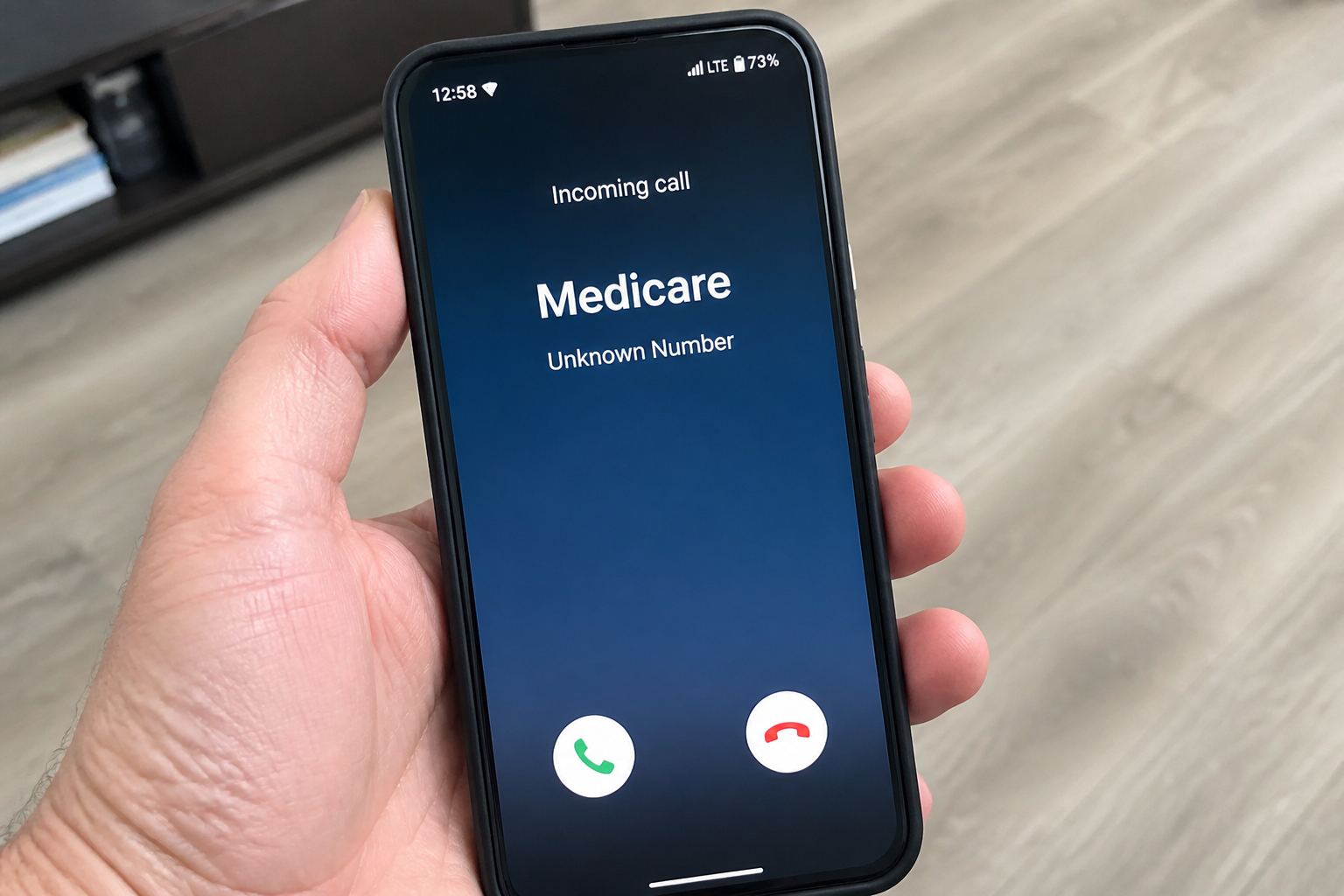
April 14, 2026. That's the date new Medicare numbers took effect for the people CMS mailed replacement cards to in March, and it's the reason this year's version of the scam call sounds plausible when it shouldn't. Medicare.gov still says it flatly: "Medicare will never call you uninvited and ask you to give us personal or private information." A caller who wants to confirm your number, mail you a plastic or chip card, or check whether your new card arrived is running the scam, and hanging up mid-sentence is a perfectly fine response.
- 1Medicare never cold-calls to confirm your number or card status.
- 2Real cards are paper only, no plastic, no chip, no annual reissue, no fee.
- 3"Black and white card" is a half-truth about home-printed replacements.
- 4Even the real 2026 reissue arrived by mail, nobody phoned first.
These calls are quieter than the ones that threaten arrest. There's no panic, no deadline you can feel. The caller sounds like clerical staff doing paperwork, which is exactly why they work.
The lines they actually use
The Senior Medicare Patrol keeps a running list of what beneficiaries report hearing. The wording is consistent enough to be useful:
- "You are getting a new, plastic Medicare card."
- "Medicare is switching to a card with a chip in it."
- "It's a new year so you need a new card."
- "You need a black and white card."
- A request to verify your Medicare number so they can confirm you have the correct card, or check whether your new one has shipped yet.
The black and white version is the cleverest of the bunch, because it's half true. Your real card has a blue banner on top and a red banner on the bottom, but if you print a replacement at home it comes out black and white. A caller who knows that sounds like they know the system.
What your card actually is
It's paper. It carries a Medicare Beneficiary Identifier, an 11-character mix of numbers and letters that replaced Social Security numbers on cards back in 2018. There's no chip, no plastic, no annual reissue, and no fee. If you lose it, you can print or order a replacement free through your account at Medicare.gov or by calling 1-800-MEDICARE (1-800-633-4227), TTY 1-877-486-2048.
Medicare does call in narrow situations. Its own language is that Medicare "will only call and ask for personal information in limited situations (like an agent or representative returning your call after you've joined a plan, reported fraud, or left a message for Medicare)." Read that as: they call you back. They don't call you first.
The 2026 reissue, and why it made this harder
This one is genuinely awkward, because for once the "you're getting a new Medicare number" story had a real version behind it. After a data incident, CMS mailed replacement cards carrying brand new Medicare numbers during March 2026, with the new identifiers taking effect April 14, 2026. Counts differ depending on who you read. One insurance industry account put it at about 1.3 million identifiers reassigned; a local aging services notice described roughly 2.8 million people receiving cards. I couldn't reconcile those two figures today, so treat the exact number as unsettled.
What isn't unsettled is how the real ones arrived. By mail. Free. On paper. With a letter explaining the change and telling recipients to destroy the old card, tell their doctors and pharmacy, and keep the new one somewhere safe. Nobody phoned first, and coverage, premiums, and plans didn't change at all. If a caller brings up the 2026 reissue as a reason you have to confirm your number, they're using a real event as a crowbar.
The enrollment calendar drives the call volume
Medicare Open Enrollment runs October 15 through December 7 every year. There's a second window, January 1 through March 31, for people already in a Medicare Advantage plan who want to switch or go back to Original Medicare. Marketing calls spike hard in both, and scam calls ride along with the legitimate ones because your phone is already ringing. This year there is an email and text version as well: messages using the MyChart patient portal's name offer a free MyChart Medicare kit for a small shipping fee, and no such kit exists.
Licensed agents are real and some are useful. Still, an agent isn't supposed to make unsolicited sales contact with you, and I couldn't pull the current CMS marketing rule text today to quote the exact provision. The practical rule holds regardless of what the regulation says this year: an unrequested sales call about your Medicare coverage is a bad sign, and you don't owe the caller a conversation. For advice with nothing attached, the State Health Insurance Assistance Program gives free one-on-one counseling at 877-839-2675 or shiphelp.org.
What they do with the number
Mostly, they bill Medicare for equipment you never received. The scale is not small. On June 30, 2025, the Justice Department announced a health care fraud takedown charging 324 defendants in schemes with $14.6 billion in intended losses, the largest such action it has announced. A single component, called Operation Gold Rush, accounted for $10.6 billion in fraudulent claims for catheters and other durable medical equipment, and DOJ said it involved the stolen identities and personal information of more than one million Americans.
Durable medical equipment fraud is the everyday version of that. Catheters, back braces, knee braces, wound supplies, and genetic test kits get billed against your number by suppliers you've never heard of. Some victims first notice because boxes start showing up at the house.
Unordered packages aren't automatically fraud on your Medicare account, to be fair. A lot of the time an unexpected box is a brushing scam, which is a different and much more boring problem involving fake reviews. Unrequested medical supplies are the ones that should make you check your claims. So are cards or letters in the box carrying a QR code, and if you get one of those you can decode the QR code from a photo without scanning it to see where it actually points before you touch it.
How to check your own record
If you have Original Medicare, the Medicare Summary Notice arrives by mail every three months and lists what was billed. Advantage and Part D plans send an Explanation of Benefits instead. Either way, log in at Medicare.gov and read the claims list directly, which is faster and more current than waiting for paper.
Look at supplier names you don't recognize and dates when you weren't seeing anyone. A charge for supplies delivered while you were out of town is the kind of thing that shows up in these cases.
If you already gave out your number
- Call 1-800-MEDICARE (1-800-633-4227) and report it, then ask them to note your record.
- Call the Senior Medicare Patrol at 877-808-2468, or find your state program at smpresource.org. They do this specific job for free and will help you read your statements.
- Report to the HHS Office of Inspector General at 1-800-HHS-TIPS (1-800-447-8477) or online at oig.hhs.gov/fraud/report-fraud.
- If you also handed over a Social Security number, bank details, or a card number, go to IdentityTheft.gov, which builds you a step-by-step recovery plan.
- Ask about a new Medicare number. It happens in identity theft cases, but it isn't automatic and I wouldn't assume you'll get one.
How worried to actually be
Less than the phone call made you feel, probably. A stolen Medicare number usually doesn't drain your bank account, because the money moves between a fake supplier and Medicare, not out of your checking. The real costs are slower and duller. Fraudulent claims can eat a benefit limit so a legitimate claim gets denied later, wrong equipment or diagnoses can end up attached to your record, and sorting it out takes phone calls you didn't want to make.
That's worth reporting promptly and not worth losing sleep over. Report it, check three months of claims, and move on.
The same phone number gets worked from louder angles too. A call claiming a grandchild is in jail and needs cash today is the grandparent scam, and it deserves a completely different reaction, starting with hanging up and calling the grandchild back yourself. For this one, go do the boring thing tonight: log in at Medicare.gov, open your claims list, and read every supplier name on it out loud.
Quick answers
- They knew my Medicare number.
- Pieces of it leak. Still hang up.
- A new card is coming?
- Check a letter you already have, or medicare.gov that you type.
This is general safety information, not legal advice. Scams change. If you need an official desk: FTC ReportFraud or IC3.