Texts and calls
The DMV traffic ticket text scam that threatens your license
Updated 6 September 2026
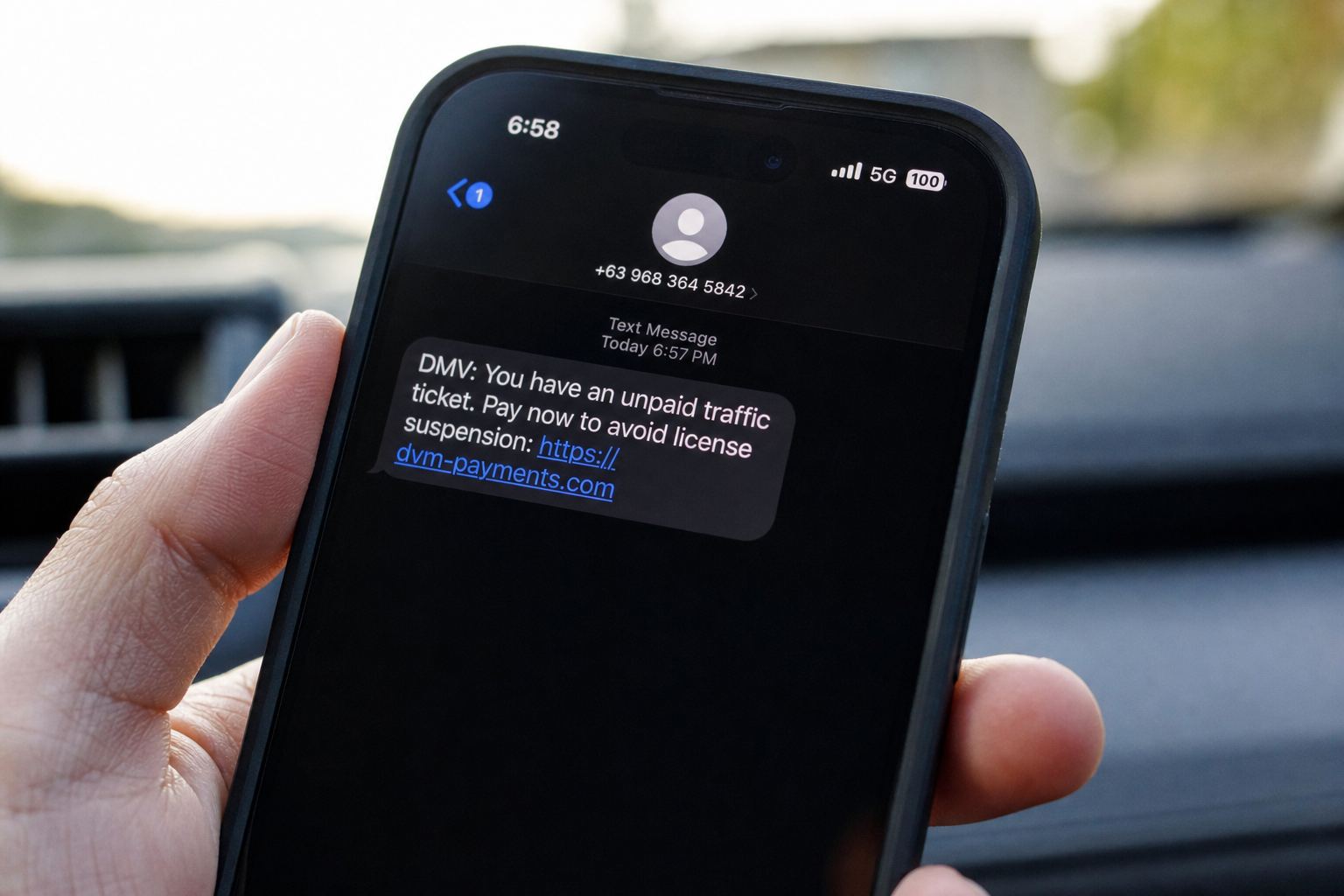
Final Notice, enforcement penalties begin in two days. That's the preview line sitting on your lock screen, and you haven't had a ticket in years. It's a scam, and your license isn't being suspended. The message is a template that's been sent in more than a dozen states with nothing changed but the state name, and in at least one case the scammers didn't even swap in the right agency.
- 1Code 15C-16.003 is copy-pasted fiction, not real state law
- 2Real DMVs never demand payment or send a payment link by text
- 3"Reply Y, exit, reopen" is a trick to reveal the suppressed link
- 4A 2-day countdown is fake urgency, real suspensions arrive by mail
State DMVs do not demand payment by text. They don't threaten you by text. They don't send you a payment link by text. What they do send by text, when they send anything at all, is dull: your registration expires next month, your appointment is Tuesday.
The template, in full
Here's the structure agencies in Florida, Alabama, North Carolina, New York, Colorado, Texas and elsewhere have all published. It opens with a header like "Department of Motor Vehicles (DMV) Final Notice: Enforcement Penalties Begin on May 24," says their records show you still have an outstanding traffic ticket, cites a state administrative code, then lists what supposedly happens if you don't pay:
- You'll be reported to the DMV violation database.
- Your vehicle registration gets suspended, starting on a specific date two days out.
- Driving privileges are suspended for 30 days.
- Your account is transferred to a toll booth, which will charge a 35% service fee.
- You may face prosecution, and your credit score will be affected.
Then a payment link. Then a closing line telling you to pay immediately to avoid license suspension and further legal disputes. Often there's a final instruction in parentheses: reply "Y," exit the message, then reopen it to make the link work.
The fake code number is the cleanest tell
Almost every version cites administrative code 15C-16.003. Florida's version calls it "Florida State Administrative Code 15C-16.003." Alabama's version calls it "alabama State Administrative Code 15C-16.003," lowercase "a" included. It's the same string, copy pasted across state lines, which is not how state law works.
The Alabama Department of Revenue went further and pointed out that the sender identified itself as the "Alabama Department of Vehicles," an agency that doesn't exist. That's the level of care going into these. It doesn't matter, because the message isn't meant to survive scrutiny. It's meant to get a reaction in the first four seconds.
Item four is where it falls apart
Read that toll booth line again. There is no mechanism anywhere in the United States by which an unpaid traffic ticket gets "transferred to a toll booth" that then adds a 35% service fee. It isn't a real process. It's a phrase that sounds bureaucratic enough to skate past you while you're worried about the license suspension two lines up, and it's a leftover from the same operation's other product, the unpaid toll text scam, which runs on the same infrastructure and often the same sender numbers.
The credit score threat is similarly hollow. DMVs don't report to Equifax, Experian or TransUnion. An unpaid court fine can eventually reach collections through a county court, and that can show up, but it takes months and it arrives as mail from a collection agency, not as a text with a countdown.
Why they ask you to reply "Y"
This one's genuinely clever, and it's the detail that convinces me these people know exactly what they're doing. Both iPhone and Android suppress tappable links from senders you've never messaged. Reply once and the suppression lifts. So the message instructs you to do it, framed as a technical formality.
Replying does two other things for them. It confirms a human is on the number, which moves you onto a better list. And it partially defeats carrier spam filtering, which is also why so many of these arrive through iMessage or RCS from an email address rather than as ordinary SMS from a phone number.
What real DMV contact actually looks like
The specifics vary by state, and that's genuinely useful, because it means you can check your own state's stated practice in about a minute.
New York's DMV texts from short code 69368, and only to people enrolled in its Electronic Reminders program, and only about expiring licenses, ID cards, registrations and inspections. Its links begin with lnks.gd and land on state government sites. Illinois goes narrower: the Secretary of State's office has said it sends texts for appointment reminders and nothing else. Virginia's DMV commissioner has said flatly that the agency will never text demanding payment for fines or fees. California's DMV says the same and points people to 800-777-0133.
The common thread is that real enforcement, the kind with consequences, arrives as paper mail to the address on your record. If a suspension were genuinely two days out, you'd have received letters weeks earlier.
The Denver case, which shows how well this works
In May 2026, nearly 200 people walked into the Denver City and County Building within about two hours of the doors opening. They'd all received a text with an image of a fake court order, a case number, a demand to pay or appear at 9 a.m., a threat of arrest, and a QR code. Court administration ended up posting signs at the entrance explaining it was a scam. Reporting at the time noted the campaign leaned heavily on Spanish speaking residents.
Denver County Court's own response is the line to remember: it will never text people about unpaid fines, and it would never use a QR code to collect one. If a message like this reaches you with a code rather than a link, you can decode the QR code from a screenshot and see where it points before you go anywhere near it.
If you already tapped through to the payment page
Sort by what you actually gave them, not by how bad it felt.
If you only opened the page and closed it, you're fine. These are harvesting sites, not exploits. Nothing installs itself because you loaded a page.
Card details are different. Call your bank now and ask for the card closed and reissued, not merely monitored. Mention it specifically if you also typed in a verification code the bank had texted you, because that code is how a stolen card gets loaded into someone else's phone wallet.
A driver's license number, date of birth or Social Security number is an identity theft problem rather than a card problem. Start at identitytheft.gov, which generates an actual recovery plan, and put a free freeze on all three credit bureaus. A freeze costs nothing and you can lift it in minutes when you need to.
How to confirm you don't owe anything
Go directly to your state's DMV site by typing the address, and use its license status check. Florida's, for example, is the MyDMV Portal driver license check at mydmvportal.flhsmv.gov. Most states offer something equivalent, free, without an account. Traffic tickets themselves usually sit with the county court that issued them, so if you want to be thorough, call the clerk of court for the county you were actually driving in, using a number you looked up yourself.
Expect a phone call next
Once you've replied or clicked, your number gets flagged as responsive, and a live caller often follows within days. Sometimes it's a fake DMV agent. Sometimes it escalates to a family emergency call using a cloned voice, which works alarmingly well on short recordings, as our page on how AI voice cloning scams work explains. Agreeing on a family safe word now costs you two minutes and closes that door.
A calm read on the risk
This scam is loud but shallow. It has no information about you, no ticket, no record, and no ability to touch your license. Its entire power sits in a fabricated deadline and a legal sounding code number that isn't real.
Three things, then you're done with it. Forward the message to 7726 so your carrier sees the sender, report it at reportfraud.ftc.gov and ic3.gov, then delete it and block the number.
Quick answers
- They named my city.
- Easy. Still do not tap.
- I already paid.
- Call the number on the back of the card, then read I typed my card.
This is general safety information, not legal advice. Scams change. If you need an official desk: FTC ReportFraud or IC3.