Texts and calls
The SIM swap text and what your carrier will actually do
Updated 6 October 2026
You assume the text is junk, and that assumption is what costs people their bank accounts. A SIM swap alert is one of the few messages where the boring thing to do, phoning your carrier on a number you find yourself, is also the only thing that works.
What a SIM swap actually is
A SIM swap is when a criminal convinces your mobile carrier to move your phone number from the SIM inside your phone onto a SIM the criminal controls. Once that switch happens, your number stops ringing on your device and starts ringing on theirs. Every SMS code your bank sends, every password reset link, every two factor prompt now lands in the attacker's pocket.
You will usually see the warning sign as a text from your carrier. Verizon, AT&T and T-Mobile all send a confirmation when a SIM change, number transfer or eSIM activation is requested. That text is the only heads up you will get, and it often arrives minutes before the criminal starts using the line.
This is not hypothetical. The FBI's Internet Crime Complaint Center logged more than 1,000 SIM swap complaints in 2024 with combined losses above $50 million, and 2025 figures tracked higher according to the IC3 annual report released in early 2026.
The tell: what the real alert looks like
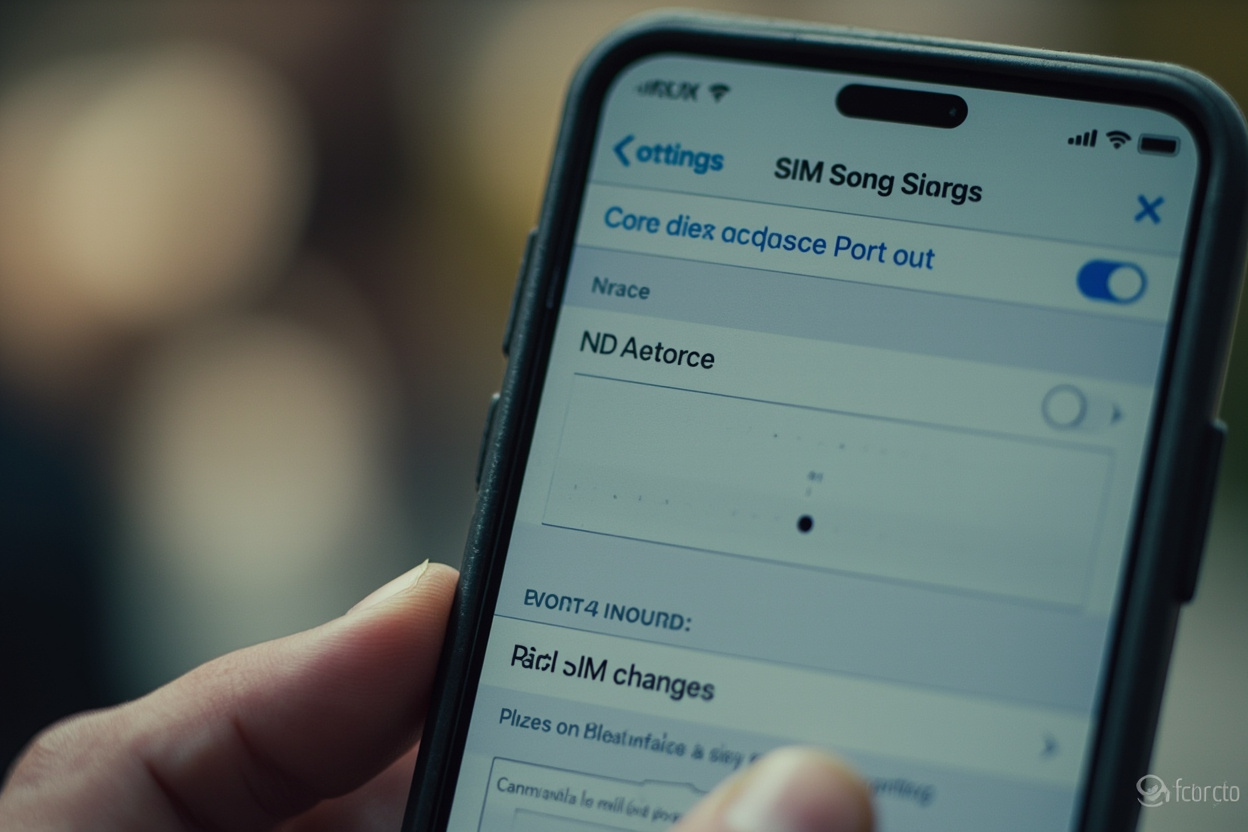
Real carrier alerts are short and operational. Verizon pushes a text that begins with a numeric code, mentions a line, a device and asks you to confirm. AT&T sends a similar message with a yes or no prompt. T-Mobile uses the phrase “SIM swap request” or “number transfer.”
Fake alerts differ. They tend to include a link, ask you to “verify” or “cancel” a pending change, and create urgency. A real alert does not require you to tap anything. It requires a yes or no reply, or nothing at all, then a call if you did not request it.
If you receive an alert and have not been in a store, on the phone with care, or inside your carrier app within the last hour, treat it as live fraud from the first second.
What your carrier will actually do
This is the part most guides skip, and the part that decides whether you keep your number.
AT&T will freeze a line on a port out request if Account Lock is on, the default for most postpaid accounts in 2026. They will not undo a completed SIM swap by text. You must call or visit a store with photo ID. AT&T's published Wireless Account Lock page sets out the controls.
Verizon's Number Lock feature, free and toggleable in the My Verizon app, blocks port outs and SIM changes until you turn it off. Once a swap is done, Verizon requires an in store identity check and a new SIM before the line is restored. The process is described in Verizon's 2025 account security update.
T-Mobile offers SIM Protection and Number Transfer PIN, both free, and tightened its port out validation after the 2023 wave of swaps. A completed swap still requires a store visit and ID to reverse, and T-Mobile's customer care cannot reverse a swap by chat alone.
The shared rule across all three: a text reply or app tap will not bring a swapped number back. A phone call to a number you find yourself, followed by an ID verified store visit, is the only path.
The law, and where it actually helps
No single US federal law names SIM swapping as a crime, but the conduct is prosecuted under existing wire fraud, identity fraud and computer fraud statutes. The Department of Justice charged a national ring in 2022 and again in 2025, with sentences ranging from 18 months to 12 years.
At state level, around half of US states now have a SIM swap specific statute or enhancement. California's SB 1476 (2018) was the first. New York passed a SIM swap law in 2022. Texas and Florida have followed. Penalties range from a felony upgrade to additional prison time layered onto the underlying fraud charge.
For you as a victim, the law matters in two ways. First, a police report gives your carrier a paper trail they will ask for when disputing fraudulent SIM swaps. Second, a police report is what your bank will want if money moves while your number was hijacked. The report does not recover the money, but it unlocks every dispute process downstream.
Recovery: the first 60 minutes
Minute zero to ten. Stop tapping links. From a different device, not your phone, log into your bank, email and any crypto account. Change passwords to ones you have not used elsewhere. If you use an authenticator app, your codes still work because they sit on your device, not your SIM.
Minute ten to thirty. Call your carrier on a number you find by typing the carrier's website into a browser yourself. Ask for a line freeze and a port freeze. Ask whether a SIM swap completed in the last hour. If yes, request a reversal and a new SIM. Go to a store with photo ID as soon as you can.
Minute thirty to sixty. Call your bank. Ask for a fraud alert on every account that uses your phone number for verification. Ask for a temporary number change on file so SMS codes route to a number only you control. If you hold crypto on a centralised exchange, the support line is faster than email and the clock is shorter than for a bank.
Hour one to twenty four. File a police report where you live, even if the crime crossed state lines. File an IC3 complaint at ic3.gov with the same details. Pull a free credit report at annualcreditreport.com and flag any new account or inquiry.
If the swap already completed hours ago
Late discovery is the common case, because most people only notice when their phone drops to no service and a stranger starts answering their messages.
By then, assume the attacker has tried every password reset on every account tied to your number. Assume your email, bank, brokerage and any crypto exchange are the priorities. The order of operations does not change, only the urgency.
What you can still do, in order. File the police report. Place a fraud alert with one of the three credit bureaus, which by law must notify the other two. Freeze your credit at all three, free under federal law and takes about fifteen minutes. Replace the SIM and the number only as a last resort, because a new number is a long recovery of its own.
What you should not do. Do not post your phone number publicly while a case is open. Do not respond to anyone who messages you on social media claiming to be the carrier's fraud team. Do not pay anyone who emails offering to recover your money for a fee, because that is the recovery room scam and it is the same criminals running it.
Carrier features worth turning on today
Three settings, free on all three networks, block the swap before it starts.
Number Lock or Port Lock. This stops the number being moved to another carrier or another SIM without an in store ID check. It is on by default for many accounts, but a recent line change or a port from a previous carrier can turn it off.
Account Lock. Stops any change to the account, including SIM swaps, address changes and port outs, without a passcode. The passcode is the weak point, so use a 6 digit one that is not your birth year and not a PIN you use elsewhere.
SIM Protection. T-Mobile's term for a feature that requires a one time confirmation before any SIM change. Verizon and AT&T have an equivalent under different names. Turn it on in the app, then test it by trying to swap to a second device.
What to say to your bank to make them listen
Banks have a SIM swap script and a SIM swap queue, but you have to land in the right one. Use the phrase “SIM swap fraud” and give the time the swap happened if you know it. Ask the bank to flag every account on your customer profile, not just the one that took the hit.
Ask for a temporary number change on file so SMS codes route elsewhere. Ask whether your account supports a hardware security key, FIDO2 or passkey, which removes the phone number from the recovery path entirely. Bank of America, Chase, Wells Fargo and most credit unions support security keys as of 2026, and the upgrade is free.
If money has already moved, the dispute is not a chargeback, it is a Regulation E claim for unauthorised electronic transfers, and the bank has ten business days to investigate under federal rules. Get the claim number in writing.
The crypto exception, and why it hurts more
Crypto exchanges move faster than banks and offer less recourse. Once a withdrawal clears, the on chain transaction is final, and a court order to a named exchange will not reverse a transfer to a self custody wallet you do not control.
If you hold crypto on a centralised exchange, the swap-to-withdrawal window is typically under 30 minutes. The only realistic defence is a hardware key for login, an allow list of withdrawal addresses, and a time locked withdrawal delay. Coinbase, Kraken and Gemini all support allow lists in 2026, and all of them are faster than SMS as a second factor.
For self custody, a SIM swap cannot touch funds that never leave the hardware wallet. If you signed a transaction, you approved it, and a SIM swap is how the attacker got you to sign. That is the harder lesson.
A short list of things that do not help
Replying STOP to the alert text. Replying YES to confirm a swap you did not request. Calling a number the alert gave you. Tapping a link in a follow up message claiming to be from the carrier's fraud team. Paying a recovery service that contacts you first. Posting about it on social media before the number is back in your control.
Each of these is either a no op, a footgun, or a second scam run by the same crew using the first as a hook.
The boring, correct response
You get a text about a SIM change you did not request. You reply STOP or you do nothing. You put the phone down. You open a browser on a laptop and type your carrier's web address yourself. You find the support number. You call. You say SIM swap fraud. You go to a store. You freeze credit. You file the report.
That sequence is dull, it is the same every time, and it is what people who keep their number and most of their money do. The exciting responses, the fast ones, the ones that feel like doing something, are the ones that lose the day.
Quick answers
- Can a SIM swap happen without any text at all?
- Yes. Some carriers send a push notification instead of a text, and a completed swap can happen in store with a convincing fake ID. Treat a sudden loss of service with no alert as the same emergency.
- Will my carrier refund money lost during a SIM swap?
- Generally no. The carrier did not move the money. Your bank's Regulation E claim is the recovery path, and a police report plus an IC3 complaint strengthen it. Some carriers have settled class actions, but those are the exception, not the plan.
- Should I get a new phone number after a SIM swap?
- Only as a last resort. A new number means updating every account, contact and two factor setting tied to the old one, and the swap does not always imply a permanent compromise of the original number.
- Is a SIM swap the same as port out fraud?
- Closely related. A port out moves your number to a different carrier, while a SIM swap moves it to a different SIM on the same carrier. The recovery steps and the bank script are the same for both.
- Do eSIMs make SIM swaps harder or easier?
- Both. eSIMs remove the physical handover criminals relied on, but they also let a swap be activated remotely, which speeds the attack. Carrier account locks matter more with eSIM, not less.
- What is the single best setting to turn on today?
- Number Lock or its equivalent on your carrier app. It is free, takes a minute, and blocks the most common path used by criminal crews in 2026.
This is general safety information, not legal advice. Scams change. If you need an official desk: FTC ReportFraud or IC3.